
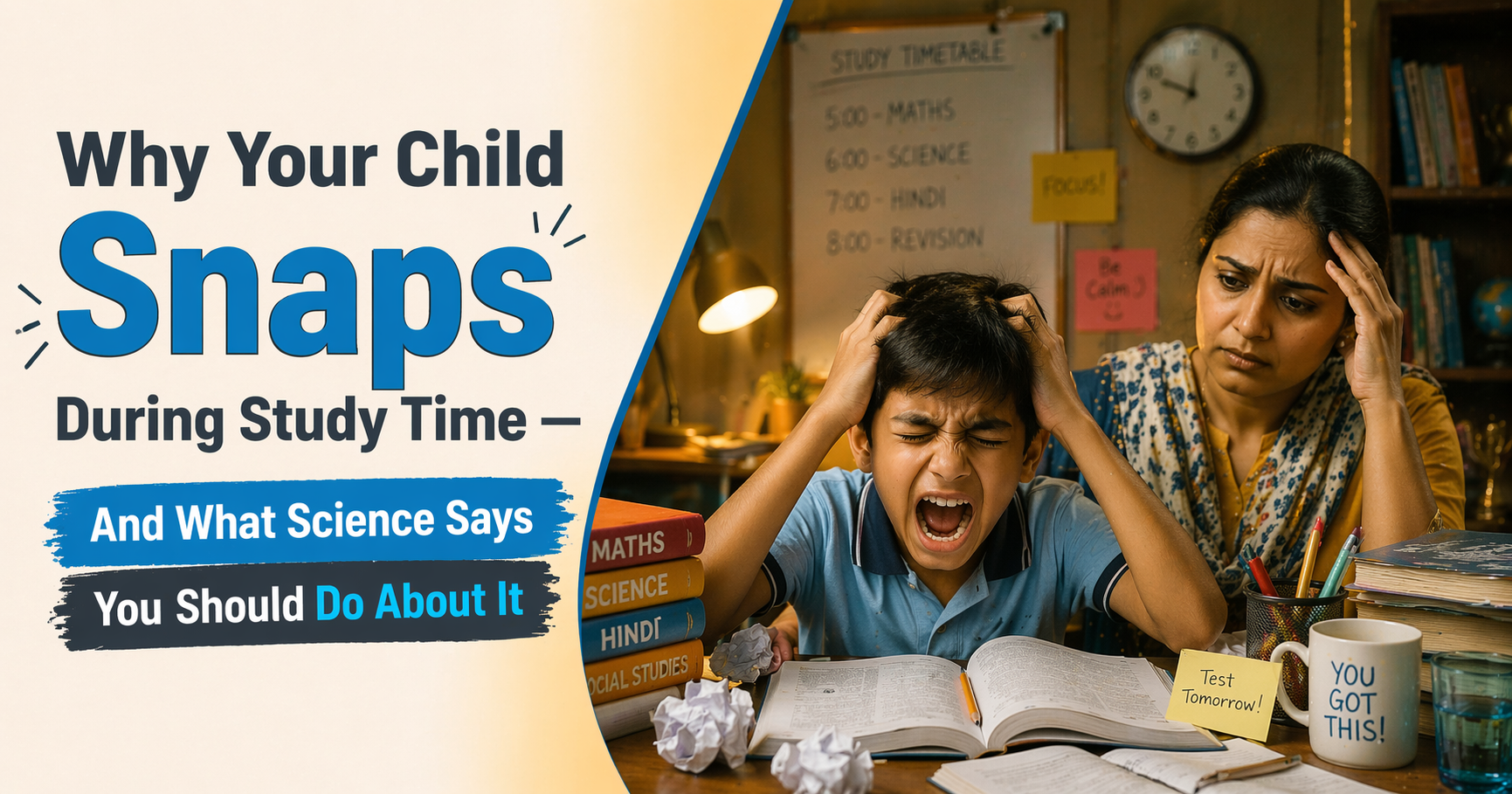
Mood Swings in Children Around Studies: Why It Happens & What You Can Do
Mood swings and irritability in children around studies are more than bad behaviour — they are a window into your child’s developing brain. Here’s what the science says, and 7 evidence-based tips from top psychologists to help your child today.
“Early adolescence is the period of greatest volatility — but adolescents gradually stabilise in their moods. Temporary mood swings might actually be normal and aren’t necessarily a reason to worry.”
— Prof. Hans M. Koot, VU University Amsterdam · Research published in Child DevelopmentIf you are a parent in Namakkal, Trichy, or anywhere across Tamil Nadu, you have likely experienced this: the moment the textbooks come out, the atmosphere at home shifts entirely. Your normally cheerful child becomes snappy, withdrawn, or tearful. You ask a simple question about homework and you are met with an eye-roll or a slammed door.
Mood swings in children around studies are one of the most common concerns parents raise in counselling sessions. As a counselling psychologist and certified career analyst who has worked with students across 22+ countries, I hear this every week: “My child is fine until it comes to studies — then I don’t recognise them.”
Understanding why mood swings occur in children around study time — and responding wisely — can make a significant difference to both your child’s wellbeing and their academic performance. Let’s unpack what is really happening, and what you can genuinely do to help.
Why do children have mood swings around studies? The real reasons
Mood swings and irritability in children around studies are not about attitude or laziness. Research from neuroscience, developmental psychology, and paediatric psychiatry points to six clear causes.
The brain is still under construction
The teenage brain develops from back to front. The emotional centre (limbic system) matures years before the rational front brain (prefrontal cortex). This means emotions fire faster than logic can manage — especially under study pressure.
Hormones hijack emotional regulation
A stress hormone called THP (allopregnanolone) that calms adults actually triggers anxiety in adolescents. Your child literally experiences more intense anxiety under pressure than you do — this is physiological, not behavioural.
Academic pressure triggers fight-or-flight
Exams, marks, and peer comparison register as genuine threats in an adolescent brain, flooding the body with cortisol and adrenaline. The “snappy” response you see is your child’s nervous system in survival mode — not rebellion.
Sleep deprivation amplifies everything
Biological shifts in adolescent sleep cycles, combined with late-night screens and study pressure, cause chronic sleep deprivation — one of the top amplifiers of mood swings, irritability, and poor concentration in children.
Identity and future anxiety collide
For a child in Class 9, 10, or 11, studies represent their entire perceived future — stream selection, career path, and family expectations. This weight is far heavier than most parents realise.
Frustrative nonreward
When hard effort produces a disappointing result — studying all night and still scoring poorly — the emotional explosion that follows is documented. Psychologists call it “frustrative nonreward,” a primary trigger for study-related irritability in adolescents.
“In the early teen years, cognitive control systems lag behind emotional development, making it hard for adolescents to cope with their emotions.”
— Dominique Maciejewski, Child Development Journal · Society for Research in Child DevelopmentA landmark study published in Child Development tracked nearly 500 teenagers from ages 13 to 18. Researchers found that mood volatility was highest in early adolescence and gradually stabilised by age 18. Anxiety followed a different curve: it spiked at the start of adolescence, dipped briefly, and rose again in the later teen years as adulthood approached.
The good news: this pattern is predictable. It is not permanent. And the single greatest factor that determines how well your child navigates this turbulent season is the quality of their home environment — specifically, how you as a parent respond to their mood swings around studies.
⚠ When mood swings in children need professional attention
Mood swings that are increasing in intensity after age 16, that interfere with eating, sleeping, friendships, or school attendance for more than two weeks, or that involve talk of hopelessness or self-harm — these are signals to consult a qualified counselling psychologist or child psychiatrist. Irritability around studies can sometimes be a masked sign of depression, anxiety disorder, or ADHD, particularly in teenage boys who rarely express sadness directly.
7 evidence-based tips to help children with mood swings around studies
These recommendations are drawn from the American Psychological Association (APA), the American Academy of Child & Adolescent Psychiatry (AACAP), Johns Hopkins Medicine, Cincinnati Children’s Hospital, and peer-reviewed developmental psychology research.
Listen first. Solve second.
When your child’s mood swings around studies escalate, resist the urge to correct or advise immediately. Research from Cincinnati Children’s Division of Behavioral Medicine confirms that simply listening without judgment is one of the most protective responses a parent can offer. Acknowledge the emotion first: “That sounds really frustrating.” Let them feel heard before any problem-solving begins. Children who feel heard de-escalate faster and are more open to guidance.
Stop tying worth to marks
MedlinePlus (US National Library of Medicine) advises parents explicitly: do not expect perfection. When your home environment communicates that marks define your child’s value, academic stress becomes existential — and mood swings around studies intensify dramatically. Make a deliberate habit of separating their worth from their performance. Say out loud: “I am proud of you for trying.” This is not softness — it is evidence-backed language that builds genuine resilience and long-term motivation.
Protect sleep like a prescription
Chronic sleep deprivation is the single biggest amplifier of mood swings in children around studies. Establish clear, consistent sleep boundaries — especially around mobile devices after 9 PM. Tufts University clinical psychologist Dr Alice Connors-Kellgren notes that sleep disruptions are among the earliest and most reliable signs of rising anxiety in adolescents. The recommended target is 8–9 hours. Protecting the hour before bed from screens and revision pressure makes a measurable difference to emotional stability the next day.
Break the syllabus into daily bites
Overwhelm from a large, unmanageable workload is one of the primary triggers of study-related mood swings in children. The AACAP and Brown University Health both recommend teaching adolescents to set small, achievable daily goals rather than week-long targets. Help your child build a simple study plan: 45 minutes of focused study, followed by a 10-minute break. This approach is not only more emotionally sustainable — research shows it produces better academic outcomes than marathon revision sessions.
Your calm is their classroom
Prof. Hans Koot of VU University Amsterdam, whose longitudinal study tracked 500 teenagers, states this directly: the single best approach for parents dealing with mood swings in children is to remain calm, composed, and patient. Your emotional regulation literally teaches your child’s developing brain what regulation looks like. When you match their escalation, their fight-or-flight response deepens. When you stay steady, you model the very skill they are trying to build. Your calmness is active, evidence-backed parenting.
Build identity outside the report card
Tufts University researchers found that community belonging — through sport, a faith community, creative activity, or a peer group — is one of the strongest protective factors against adolescent mental health struggles. Children who have a strong sense of identity outside academics are significantly more resilient when study pressure mounts. Ensure at least one or two activities each week are entirely non-academic, non-competitive, and purely for joy. This is a mental health necessity, not a luxury.
Seek professional support early — not as a last resort
Johns Hopkins Medicine and APA Division 53 both emphasise that consulting a counselling psychologist when mood swings in children around studies are persistent is a sign of parental wisdom, not failure. Cognitive-Behavioural Therapy (CBT) has a strong evidence base for reducing study anxiety and emotional dysregulation in adolescents. Parent Management Training (PMT) — where parents learn structured response strategies — is equally well-evidenced. If your child’s irritability is disrupting home life or school attendance, do not wait.
Frequently asked questions by parents
Are mood swings in children around studies normal?
Yes — to a significant degree. Research from the Society for Research in Child Development confirms that mood volatility is highest in early adolescence and gradually stabilises by age 18. However, if mood swings are intensifying rather than stabilising after age 15–16, or are interfering with daily life for more than two weeks, professional support is recommended.
Why does my child become aggressive or cry only during study time?
Study time concentrates the highest sources of stress for a child — performance expectations, fear of failure, uncertainty about the future, and peer comparison — all at once. This creates an emotional tipping point. The aggression or tears are not targeted at you. They are the overflow of a nervous system that has reached its coping limit.
How do I know if my child needs a counsellor for mood swings around studies?
Look for these signs: mood swings lasting more than two weeks, withdrawal from friends or family, loss of interest in activities they previously enjoyed, changes in sleep or appetite, or any mention of hopelessness. If two or more of these are present alongside study-related irritability, a consultation with a counselling psychologist is the right next step.
Does career confusion make study-related mood swings worse?
Absolutely. One of the most under-recognised causes of study-related emotional struggles is career ambiguity. When a child does not know why they are studying or what they are working towards, motivation drops and anxiety rises sharply. A structured career counselling session — exploring personality, interests, and a clear roadmap — often produces a dramatic improvement in both study motivation and emotional stability.
Mood swings in children around studies are not a character flaw. They are not ingratitude or laziness. They are the predictable result of a developing brain navigating enormous biological change alongside academic pressure that has never been higher for this generation of Indian students.
The students I counsel in Namakkal, Trichy, and across Tamil Nadu are carrying real weight — and most of them do not yet have the emotional vocabulary to express it. What they need most is not a quieter child. It is a steadier parent.
Your consistent presence, your calm in the face of their storm, and your genuine curiosity about who they are becoming — not just what marks they are scoring — is the most powerful and evidence-backed intervention available to you.
“Parents can help teens cope with some challenges simply by listening to their concerns and offering a reassuring presence.”
— Tufts University School of Medicine, 2024If your child’s mood swings around studies are persistent, or if they are struggling with stream selection, career confusion, or exam anxiety, a one-on-one session at Chirpy Heart can give both of you clarity, direction, and a plan.
Guiding Careers. Bridging Dreams. Book a counselling sessionCertified Career Analyst (CCA) · Counselling Psychologist
MBA, MA (Counselling Psychology), MA (Family & Marriage Counselling)
Chirpy Heart Career & Overseas Solutions · chirpyheartcounseling.in
Namakkal & Trichy, Tamil Nadu
